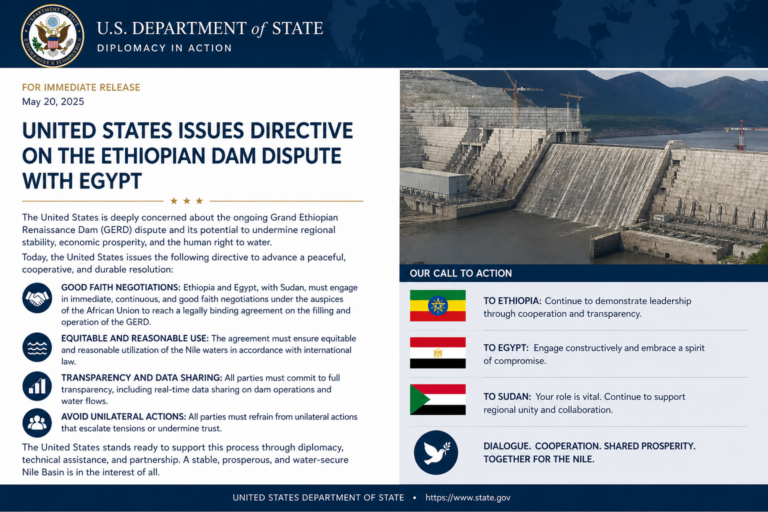
WASHINGTON (HornPost) — The United States is pushing for a peaceful solution to the dispute over Ethiopia’s Grand Ethiopian Renaissance Dam (GERD), senior presidential adviser Massad Boulos said Monday.
Boulos, the White House adviser for African, Arab and Middle Eastern affairs, said negotiations should focus on technical solutions rather than political confrontation.
“We are working to achieve a suitable solution for all parties, particularly through a technical framework,” Boulos told Al Arabiya. He said the issue was technical and should be resolved through technical discussions.
US Calls for Cooperation Between Egypt and Ethiopia
Boulos described the dispute as a matter of “life and death” for Egypt, Sudan and Ethiopia. He also acknowledged that the dam had been completed and officially inaugurated.
The challenge now, he said, is to find an agreement that recognizes the dam’s existence while addressing the concerns of all parties.
Boulos said Washington continued to encourage peaceful cooperation between Cairo and Addis Ababa. He described the two countries as having a historic relationship that should not lead to hostility.
During recent visits to Egypt and Ethiopia, Boulos said he discussed the dispute with officials from both governments. He also reaffirmed the strength of U.S.-Egyptian relations.
Trump’s Earlier Mediation Efforts
Boulos said the GERD dispute remained a strategic priority for President Donald Trump.
During Trump’s first administration, the United States helped facilitate negotiations between Egypt, Ethiopia and Sudan. The talks took place between November 2019 and February 2020, with the World Bank also involved.
The negotiations produced a draft agreement that was expected to be signed in Washington. However, the process stalled before a final deal was reached.
The African Union later led efforts to resolve the dispute, but those negotiations also failed to produce a comprehensive agreement.
Asked whether Trump might again mediate between Egyptian President Abdel-Fattah El-Sisi and Ethiopian Prime Minister Abiy Ahmed, Boulos expressed support for renewed diplomatic efforts.
“God willing, we will see that together. That is our goal,” he said.
Boulos suggested that a meeting could take place within an African framework, possibly alongside an African Union event. He said Washington was ready to support initiatives aimed at a peaceful settlement.
El-Sisi Warns Over Egypt’s Water Security
Egyptian President El-Sisi renewed his warning over Ethiopia’s management of the dam on Sunday.
Speaking during the eighth Cairo Water Week, El-Sisi said Egypt “will not stand idly by” in response to what he described as Ethiopia’s irresponsible actions. He pledged to take all necessary measures to protect Egypt’s water security.
He also defended Egypt’s reliance on diplomacy and international institutions, particularly the United Nations.
El-Sisi said Egypt’s commitment to dialogue should not be mistaken for weakness. Instead, he described it as a sign of strength and a commitment to cooperation among Nile Basin countries.
Egypt and Sudan have repeatedly opposed what they consider Ethiopia’s unilateral approach to operating the dam. Both countries have raised concerns about the potential effects on downstream water supplies.
Egypt and Sudan Raise Safety Concerns
In September, Egypt’s and Sudan’s water ministers, Hani Sweilam and Ismat Qureshi, raised concerns about the dam’s implications for regional stability.
They called on Ethiopia to reconsider its approach and cited concerns over structural safety, water releases and drought management.
Ethiopia maintains that the dam is central to its development plans and electricity generation. Egypt and Sudan, meanwhile, have sought binding arrangements governing how the dam operates during droughts and how water releases are coordinated.
The three countries have yet to reach a comprehensive agreement that resolves their differences over the dam’s operation and its potential impact on downstream states.
Nile Water Remains a Major Concern for Egypt
Egypt depends heavily on the Nile River for its water supply. The government says the country requires more than 90 billion cubic meters of water annually, while its share under existing agreements is 55.5 billion cubic meters.
Egypt’s Foreign Ministry has also reported that annual per capita water availability has fallen below 500 cubic meters. That level is below the United Nations’ commonly cited water-scarcity threshold.
The dispute over the GERD remains a major source of tension in the Nile Basin. Any lasting agreement will need to address Ethiopia’s development priorities as well as Egypt’s and Sudan’s concerns about water security.
Washington’s latest statements signal continued interest in diplomacy. Whether renewed mediation can bridge the differences between the three countries remains uncertain.
HornPost Staff
info@hornpost.com
www.hornpost.com
Hargeisa, Somaliland