MOSCOW (HornPost) — Russia and African leaders have agreed on a new three-year cooperation plan covering trade, security, energy and technology following a two-day summit in Moscow.
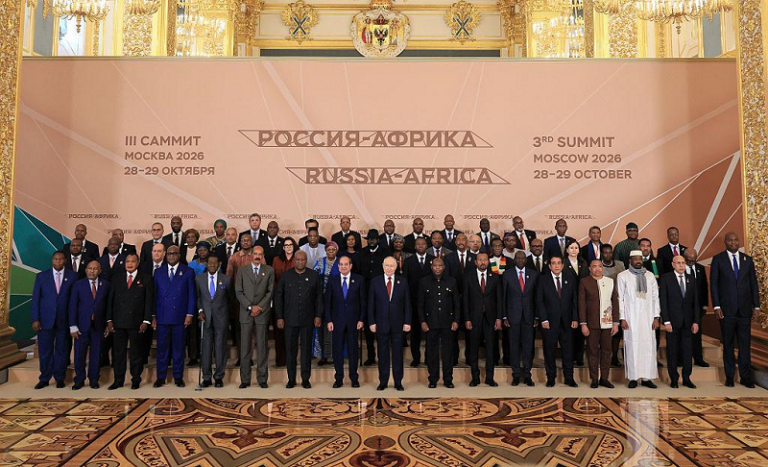
The third Russia-Africa Summit took place on October 28–29 under the theme “For Peace, Security and Development.” It brought together representatives from 48 African countries, including 22 heads of state and government.
Russian President Vladimir Putin and Burundi’s President Évariste Ndayishimiye, who chairs the African Union, co-chaired the meeting.
Three Key Documents Adopted
The summit concluded with the adoption of three major documents.
They include the final declaration of the summit, an action plan for the Russia-Africa Partnership Forum covering 2027–2029, and a declaration on cooperation in the civilian use of artificial intelligence.
The new action plan is intended to guide cooperation between Russia and African countries over the next three years.
It also sets priorities for political dialogue, economic development and technology partnerships.
Trade and Investment Take Centre Stage
Trade and investment featured prominently during the discussions.
Putin said Russia’s trade with African countries exceeded $27 billion in 2025. He called for stronger economic ties and greater investment in African markets.
The Russian president also highlighted opportunities in agriculture, energy, mining, transport and industrial development.
Food security was another major issue. Russia expressed its readiness to expand cooperation with African countries on grain supplies, fertilisers and agricultural production.
Security and International Relations
The leaders also discussed security challenges across Africa.
The final declaration calls for stronger cooperation against terrorism and violent extremism. It also supports efforts to resolve conflicts through African-led initiatives.
In addition, Russia and African countries expressed support for reforming international institutions.
The declaration backs greater African representation on the United Nations Security Council and international financial institutions.
It also addresses the historical impact of colonialism. The participating countries agreed to pursue legal mechanisms to assess and seek compensation for damage caused to Africa during the colonial period.
The document also supports the return of African cultural artefacts taken during the colonial era.
Technology, Education and Healthcare
Technology was another important area of cooperation.
The separate declaration on artificial intelligence focuses on its civilian applications. The leaders also discussed digital development, scientific research and technology transfer.
Meanwhile, the summit highlighted cooperation in education and healthcare.
Proposals include expanding university exchanges, training medical professionals and strengthening African countries’ ability to respond to disease outbreaks.
The final declaration also identifies cooperation between media organisations as an area for further development.
African Union Calls for Practical Results
African Union Chairperson Évariste Ndayishimiye stressed the need to turn political commitments into practical projects.
He called for cooperation that supports industrialisation, local processing of raw materials, infrastructure development and employment.
The summit also provided an opportunity for African countries to pursue bilateral agreements with Russia.
Reports following the meeting said around 150 cooperation documents were signed across different sectors, including education, healthcare, trade, transport and agriculture.
Implementation Will Be the Main Test
The Moscow summit marks another effort by Russia to expand its political and economic relations with Africa.
For African countries, the partnership offers potential opportunities in investment, energy, agriculture, education and technology.
However, the success of the agreements will depend on implementation.
The 2027–2029 action plan will provide a framework for cooperation. Its impact will ultimately depend on whether the commitments lead to investment, job creation, technology transfer and measurable improvements in African economies.